Retirement accounts
Pension vs 401(k): The Real Difference Is Who Carries the Risk
Pension vs 401(k): the real difference is who carries the risk. A pension puts investment and longevity risk on your employer. A 401(k) puts both on you.

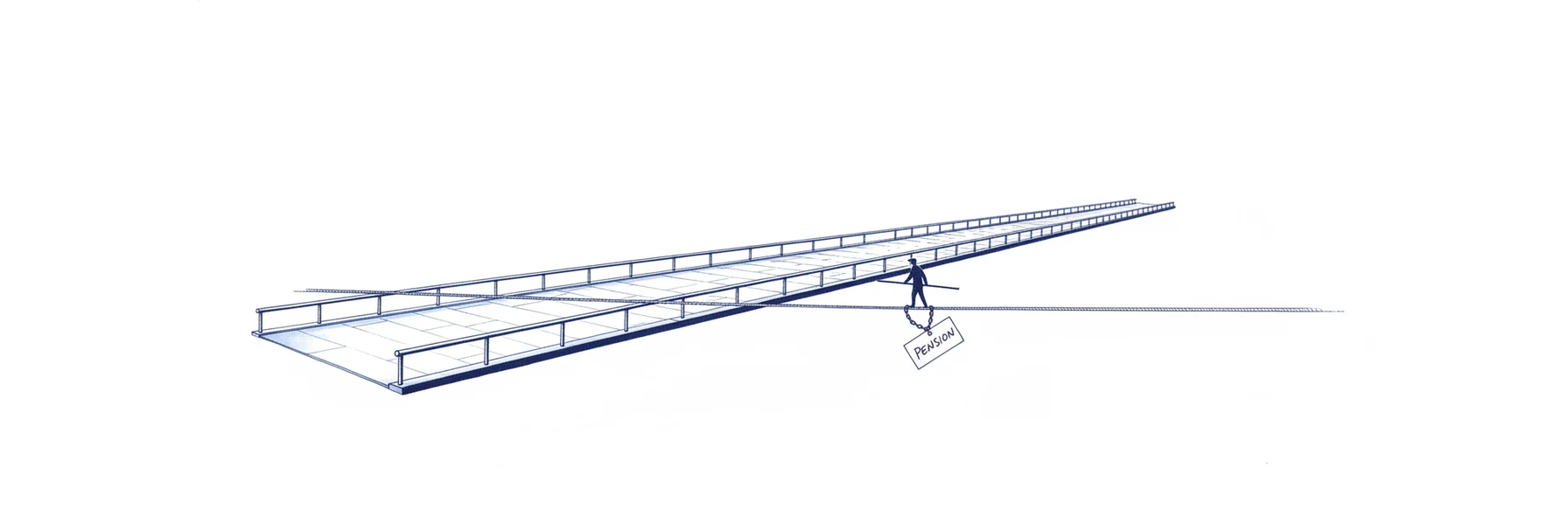
A pension and a 401(k) both convert your working years into retirement income. They differ in one thing that matters more than everything else combined: who absorbs the loss when things go badly.
A pension is a promise from your employer to pay you a set amount every month for as long as you live. A 401(k) is an account with your name on it, and whatever is in it the day you stop working is what you get. The pension vs 401(k) comparison usually gets framed as "guaranteed versus market-based," which is close but misses the mechanism. The real distinction is that a pension moves investment risk and longevity risk off your balance sheet and onto your employer's. A 401(k) leaves both squarely on yours.
That single structural fact explains nearly everything downstream: vesting rules, portability, survivor benefits, and why your employer almost certainly stopped offering the pension.
The difference between a pension and a 401(k), in one line
Formally, a pension is a defined benefit plan and a 401(k) is a defined contribution plan. The names are literal. In a defined benefit plan the benefit is fixed and the contributions are whatever it takes to fund it. In a defined contribution plan the contribution is fixed and the benefit is whatever it happens to turn into.
Here is the ledger of who is exposed to what:
| Risk | Pension | 401(k) |
|---|---|---|
| Markets fall before you retire | Employer | You |
| Markets fall after you retire | Employer | You |
| You live to 100 | Employer | You |
| Inflation erodes the payment | Usually you | You |
| Your employer goes bankrupt | You, above the PBGC cap | Not exposed |
| You change jobs | You | Not exposed |
Three rows favor the pension outright. One is a wash. Two favor the 401(k), and those two are not small, which is why "is a pension better than a 401(k)" has no clean answer.
What a pension actually promises
How the payment is calculated
Almost every pension runs on a formula of the same shape:
annual benefit = multiplier × years of service × final average salary
A plan with a 2% multiplier, for someone with 25 years of service and a final average salary of $80,000, pays 0.02 × 25 × $80,000 = $40,000 a year. Every year. Until you die.
Notice what is not in that formula: market returns. If the plan's assets fall 30% the year after you retire, your $40,000 does not move. The employer has to close the gap out of future contributions. That is the entire deal.
Survivor benefits are built into the structure
Under ERISA, the default payment form for a married participant in a private pension is a qualified joint and survivor annuity: the benefit is reduced somewhat while you are alive, and at least half continues to your spouse after you die. Electing a single-life payment instead requires your spouse's written, witnessed consent. The protection is structural. You have to actively opt out.
A 401(k) has no equivalent, because there is no stream to continue. The balance passes to whoever is named on the beneficiary form, which overrides the will. If the balance is $60,000, your spouse inherits $60,000. If you had already spent it down, they inherit nothing.
What a 401(k) actually promises
Nothing. That is not a criticism, it is the design. A 401(k) gives you a tax wrapper, an employer match if the plan offers one, and the market. What comes out depends on how much went in, what it earned, and (the part almost nobody prices) the order in which it earned it.
Why the order of returns matters as much as the average
Take five people retiring the same day on the same $40,000 of first-year income. One has a pension. The other four each have $1,000,000 and withdraw $40,000 a year, the familiar 4% starting rate.
Hand all four of the 401(k) retirees the identical 25 annual returns (arithmetic mean exactly 7%) and change one thing only: which years the six losing years land on.
When the six losing years fall in years 1 to 6, the income stops in year 10. Push the same six losing years out to years 7 to 12 and the money lasts until year 20. Push them to years 11 to 16 and the retiree finishes year 25 with $920,579 still in the account. Identical returns. Identical average. Radically different retirements.
The mechanism is straightforward. Withdrawing a fixed dollar amount from a falling balance means selling a larger share of the portfolio each year, and shares sold near the bottom are not there for the recovery. A 37% loss in year 1 compounds against you for 24 more years; the same loss in year 20 barely registers.
Which raises the obvious question: can the bad years be seen coming? That is a question about macro indicators rather than about plan design, and it is not one the structure of a 401(k) answers either way.
Is a pension better than a 401(k)?
Not automatically. Three things the "guaranteed income" framing tends to skip:
Inflation
Most private-sector pensions pay a fixed nominal amount with no cost-of-living adjustment. At 3% inflation, $40,000 a year buys about $29,800 of today's goods after 10 years and $22,100 after 20. The number on the check never changes; what it buys falls by nearly half over a normal retirement. A 401(k) invested in equities has at least a mechanism for keeping pace. A fixed nominal pension has none. Buying that guaranteed-income structure on the open market instead is what an annuity is, and why it is insurance rather than an investment. Public-sector plans frequently do include a cost-of-living adjustment, which is a large part of why they look so much stronger than private ones.
Your employer's solvency
A pension is an unsecured promise from a company. If the company fails, the Pension Benefit Guaranty Corporation steps in for most private single-employer plans. But the guarantee is capped, and the cap bites hardest on long-tenured high earners, precisely the people with the largest promised benefits. Public-sector plans are not covered by the PBGC at all.
A 401(k) balance is held in trust and is not a claim on your employer. Your employer can file for bankruptcy on Monday and your 401(k) is untouched Tuesday.
Whether you actually stay
This one quietly does the most damage, and it gets its own section.
Vesting and portability: what you keep if you leave
Both plan types can make you wait before you own the employer's money. Federal law caps how long that wait can be, and the caps are different.
For a 401(k), your own salary deferrals are 100% yours from the first paycheck. Always, with no exceptions. Only the employer's contributions can be subject to a schedule, and the slowest one permitted is 20% after two years rising to 100% after six. The two schedule shapes, and what a badly timed resignation forfeits under each, are laid out in what vested actually means in a 401(k).
For a pension, the employer is allowed to impose a five-year cliff. Leave at four years and eleven months and you walk away with nothing at all.
But vesting is the smaller problem. The bigger one is hiding inside that formula: a pension multiplies your final average salary, and the moment you leave, that number freezes at whatever you were earning on your last day.
Run the same career two ways. Stay 25 years and finish at $80,000: 0.02 × 25 × $80,000 = $40,000 a year. Now split the identical career into two 12.5-year stints, leaving the first at $55,000 and the second at $80,000:
- 0.02 × 12.5 × $55,000 = $13,750
- 0.02 × 12.5 × $80,000 = $20,000
- Total: $33,750
Same work, same ending salary, 16% less pension. And the $13,750 piece typically sits frozen in nominal dollars for decades before it starts paying, quietly losing purchasing power the whole time.
A 401(k) does not care. The balance rolls into an IRA or a new employer's plan and keeps compounding as though nothing happened. For someone who changes employers five or six times across a career (closer to the American norm than staying 25 years), that difference changes the arithmetic considerably.
Why most people with a pension today work for the government
Private-sector pensions did not fail. They were closed.
And what the closures left behind is not an even spread. It is a split running down the middle of the labour market.
The 401(k) began as an obscure 1978 tax provision and was never designed to replace pensions. It did anyway, because it let employers convert an open-ended, market-sensitive balance-sheet liability into a predictable, budgeted expense. Defined contribution plans as a group (profit-sharing and thrift plans at first) passed pensions in active participants back in 1984, according to Department of Labor Form 5500 filings; the 401(k) then became the dominant form they took. Accounting rules that pushed pension shortfalls onto company financial statements accelerated the exit.
In March 2025, 14% of private-sector workers had access to a defined benefit plan and 9% were actually in one, and much of even that is frozen, accruing nothing new. State and local government barely moved: 86% access, 74% participating. If someone tells you they have a pension in 2026, the odds heavily favor a teacher, a firefighter, a police officer, or a civil servant.
Can you have both a pension and a 401(k)?
Yes, and millions of people do. Nothing in the tax code prevents you from accruing a defined benefit and contributing to a defined contribution plan in the same year. The elective deferral limit ($24,500 for 2026, plus an $8,000 catch-up from age 50) applies to you, not to the combination.
The most common version is exactly the public-sector case above: a teacher or state employee with a pension plus a 403(b) or a 457(b) on the side. The 457(b) is structurally distinct here, because its contribution limit sits separately from the 403(b) and 401(k) limit, so someone with access to both plan types can defer into each.
One wrinkle runs the other direction. Being an active participant in any employer plan (including a pension you were auto-enrolled in and never thought about) triggers income phase-outs on the deductibility of traditional IRA contributions. The pension can quietly close a door somewhere else in the tax code.
What the comparison actually reduces to
Strip away the framing and two questions remain.
The first is about risk. A pension converts an uncertain, path-dependent outcome into a fixed one, and the price of that conversion is inflation exposure plus dependence on one employer's solvency. A 401(k) does the reverse: it hands you the upside, the downside and the sequence risk, and asks you to manage all three.
The second is about arithmetic, and it is the one most people get backwards. The pension formula rewards a long, uninterrupted career at one employer with rising pay. The 401(k) rewards contribution rate and time in the market, and is indifferent to how many logos appear on your resume. Neither structure is better in the abstract. They reward different career shapes — and the shape most Americans now have is not the one pensions were built for.