Retirement accounts
Roth IRA vs Traditional IRA: The Whole Decision Is One Variable
Roth IRA vs traditional IRA hinges on one variable: your tax rate now vs in retirement. The proof, the 2026 numbers, and four tie-breakers that decide it.

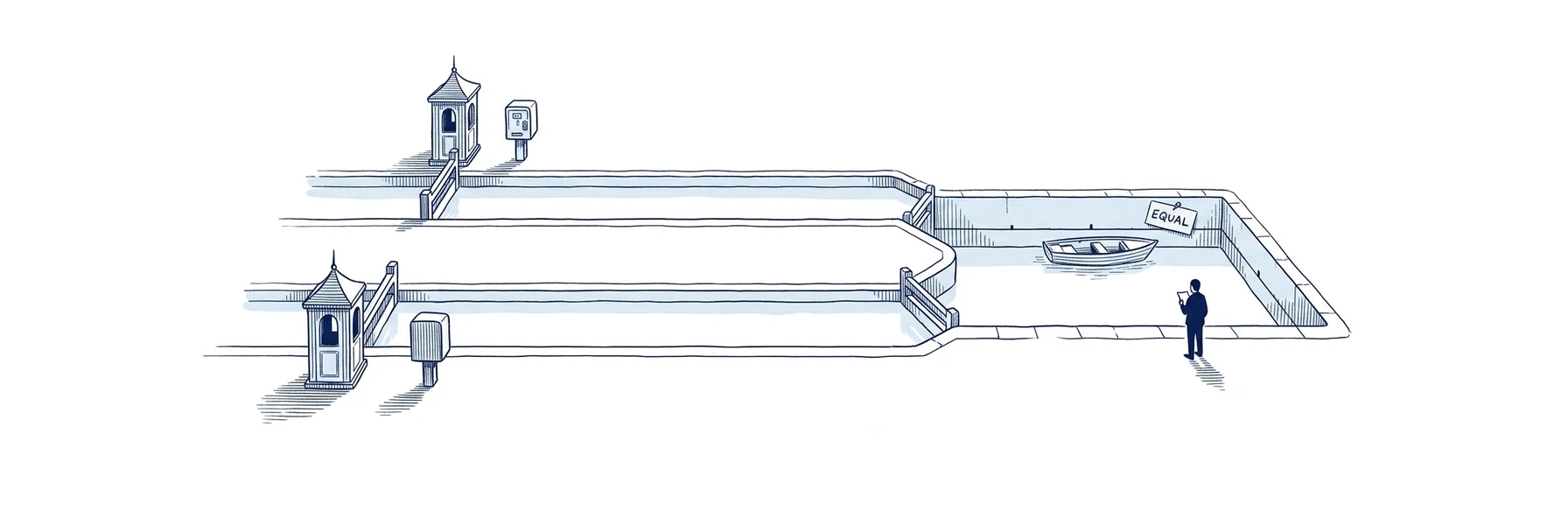
Roth IRA vs traditional IRA is the rare financial question with an exact answer hiding under a mountain of opinion. Strip away the jargon and the whole decision reduces to one variable: the tax rate you pay on that money today versus the tax rate you will pay on it in retirement. Everything else is a footnote to that comparison.
Here is the number that reframes the debate. When those two rates are equal, the accounts end in an exact tie. A $7,500 pre-tax contribution at a 22% tax rate, compounding at 7% per year for 30 years, becomes $44,532 of spendable money either way. Not roughly the same. Identical to the dollar. Almost nobody arguing about this online seems to know it.
I build backtesters and Monte Carlo engines in Python for a living, and I am suspicious of any retirement debate that never writes the equation down. So this piece takes the quant route: prove the tie first, then enumerate the four asymmetries in the real tax code that break it. For this article I ran the arithmetic three ways, closed-form, year-by-year in a spreadsheet, and through our lab tool, and they agree to the dollar, because this is one of the few questions in finance that is purely deterministic once you fix the assumptions.
The mechanics in one table
Both accounts are containers, not investments. Inside either one you can hold the same index funds, the same stocks, the same ETFs (the menu is covered in what you can hold in a Roth IRA, and it applies to traditional IRAs too). The only structural difference is when the IRS takes its cut.
| Traditional IRA | Roth IRA | |
|---|---|---|
| Money going in | Pre-tax, if you qualify for the deduction | After-tax |
| Growth | Untaxed while inside | Untaxed while inside |
| Money coming out | Taxed as ordinary income | Tax-free when qualified |
| 2026 contribution limit | $7,500, plus $1,100 catch-up at 50+ | Same limit, shared across both accounts |
| Income cap on contributing | None, but the deduction phases out | Phase-out starts at $153,000 MAGI (single) |
| Required minimum distributions | Yes, from age 73 (75 if born in 1960 or later) | Never during your lifetime |
The 2026 limit is $7,500, with a $1,100 catch-up for savers 50 and older, so $8,600 total. That limit is shared: $7,500 across all your traditional and Roth IRAs combined, in any mix you choose.
Traditional means taxed later. Roth means taxed now. The entire question is which side of "later" your tax rate sits on.
At equal tax rates, the two accounts end in an exact tie
Write down what actually happens to a dollar. Say you have $7,500 of pre-tax salary to save, your tax rate is t, and your investments grow by a factor G over the years until retirement.
In a traditional IRA, the full $7,500 goes in, grows to $7,500 × G, and gets taxed on the way out:
Traditional ending wealth = $7,500 × G × (1 − t)
In a Roth, the tax comes first. You keep $7,500 × (1 − t), it grows by the same G, and comes out untouched:
Roth ending wealth = $7,500 × (1 − t) × G
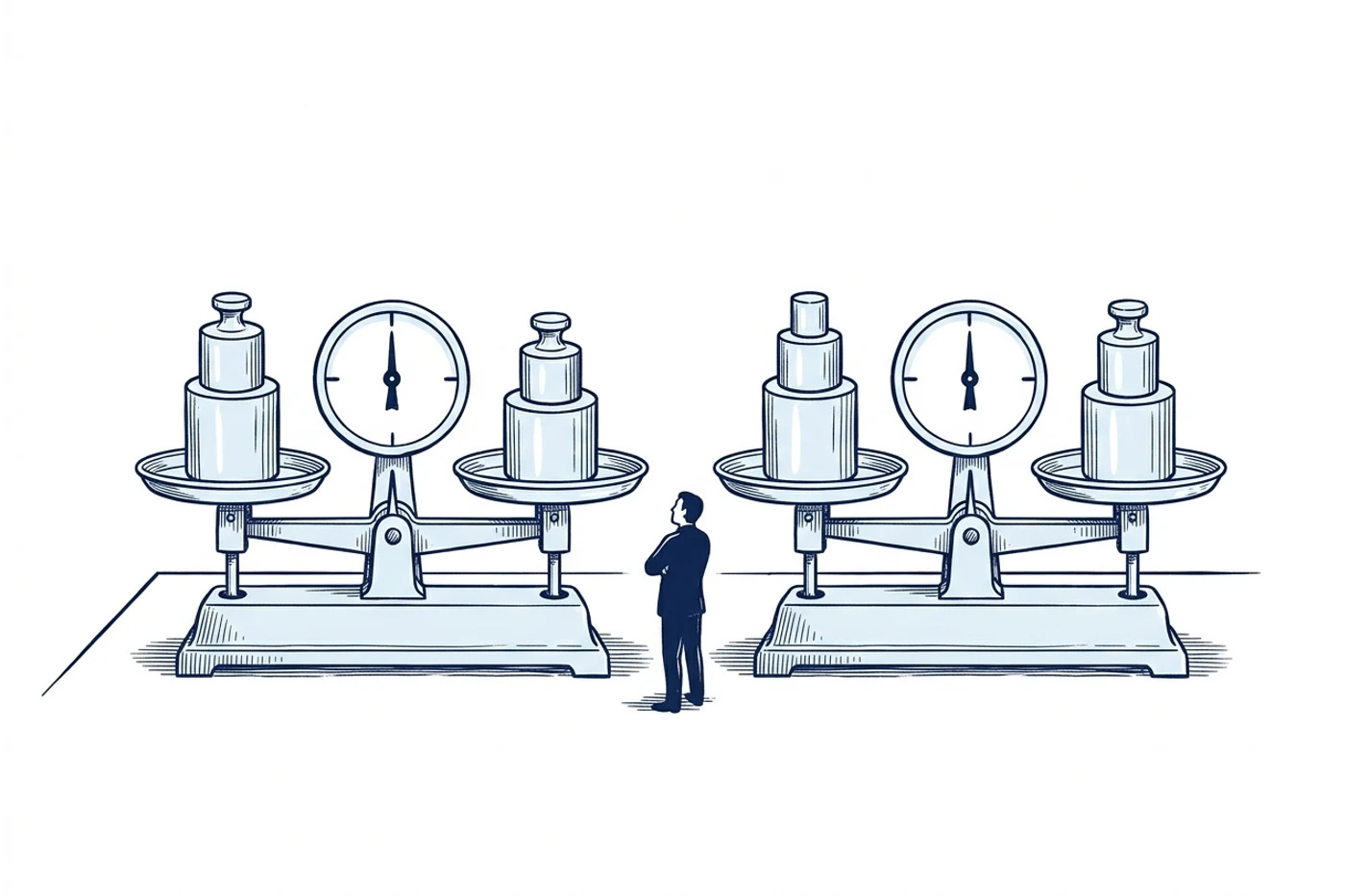
Same three factors, different order — and multiplication does not care about order. If the tax rate is the same at both ends, the accounts are mathematically indistinguishable. Here it is with real numbers: 22% tax rate, 7% annual growth, 30 years (growth factor 7.61).
| Step | Traditional | Roth |
|---|---|---|
| Pre-tax budget | $7,500 | $7,500 |
| Invested today | $7,500 | $5,850 after 22% tax |
| Balance after 30 years at 7% | $57,092 | $44,532 |
| Tax due on withdrawal at 22% | $12,560 | $0 |
| Spendable wealth | $44,532 | $44,532 |
The Roth's bigger headline balance is an illusion: the traditional account carries an embedded tax liability, and at equal rates that liability exactly offsets the head start. This tie is the null hypothesis of the entire debate. Every legitimate argument for one account over the other is really an argument about why your two tax rates will not be equal.
When the rates differ, the answer is one division
Break the symmetry and the comparison collapses to a single ratio. For the same pre-tax budget, Roth wealth divided by traditional wealth equals (1 − rate now) / (1 − rate in retirement). Above 1, Roth ends richer. Below 1, traditional does. The growth rate and the horizon cancel out completely, which surprises people: how well the market does has no effect on which account wins, only on the size of the pot.
A saver contributing at a 22% rate who withdraws at an effective 8% ends up with about 15% less wealth by choosing Roth. The same saver withdrawing at 32% ends up about 15% ahead with Roth. So the real work is estimating which side you will land on. That is where the four asymmetries come in.
Tie-breaker 1: contributions dodge your marginal rate, withdrawals pay your effective rate
This is the asymmetry most people miss, and it quietly tilts the field toward traditional for many earners. A traditional contribution comes off the top of your income, so it escapes your highest bracket. A traditional withdrawal in retirement does the opposite: if it is your main income, it fills the brackets from the bottom, starting with the 0% slice created by the standard deduction.
Run a $60,000 traditional IRA withdrawal through the 2026 federal brackets for a single filer aged 65 or older, assuming it is the only taxable income:
| Slice of the withdrawal | Amount | Rate | Tax |
|---|---|---|---|
| Standard deduction $16,100 + age-65 addition $2,050 | $18,150 | 0% | $0 |
| 10% bracket (to $12,400 of taxable income) | $12,400 | 10% | $1,240 |
| 12% bracket | $29,450 | 12% | $3,534 |
| Total | $60,000 | 8.0% effective | $4,774 |
Look at the round trip. Each dollar contributed at a 22% or 24% marginal rate avoided 22 to 24 cents of tax going in, and on this retirement profile pays about 8 cents coming out. Through 2028 there is also a temporary extra $6,000 deduction for filers 65 and older, which pushes the effective rate on that same withdrawal down to 6.8% while it lasts.
Two honest caveats. First, this assumes the IRA withdrawal sits at the bottom of your income stack. Social Security, a pension, or rental income eats the low brackets first, and every additional dollar of traditional withdrawal then lands at higher rates. Second, brackets are legislated, and 2026 law is not a promise about 2056 law. But the structural point survives both caveats: you save at the top of your bracket stack and withdraw across all of it. That asymmetry favors traditional, and it is strongest for high earners contributing in the 24% bracket and above.
Tie-breaker 2: $7,500 in a Roth is bigger than $7,500 in a traditional IRA
The contribution limit is written in nominal dollars, and that creates a loophole in Roth's favor for anyone maxing out. $7,500 of after-tax money is worth more than $7,500 of pre-tax money. At a 22% rate, a maxed Roth contribution is equivalent to sheltering $9,615 of pre-tax income. The Roth limit is effectively 28% higher.
Watch it play out over 30 years at 7%. The maxed Roth ends at $57,092, all spendable. The maxed traditional ends at $44,532 after tax, plus whatever became of the $1,650 tax refund the contribution generated. Invest that refund in a taxable account earning the same 7%, drag it down to roughly 6% after annual taxes on distributions, and it grows to about $9,477. Total for the traditional strategy: about $54,008. The Roth ends roughly $3,083 ahead, about 5.7%, purely because more effective money fit under the same nominal cap.
So the two structural asymmetries point in opposite directions: bracket-filling favors traditional, the limit favors Roth for maxers. Which one dominates depends on your rates, which is exactly why generic advice fails.
Tie-breaker 3: only one of the two ever forces money out
Traditional IRAs come with required minimum distributions. Under current law you must start withdrawing at age 73, and SECURE 2.0 schedules the start at 75 for anyone born in 1960 or later. Each RMD is taxable income whether you need the money or not, and large balances can push retirees into brackets they spent decades avoiding.
Roth IRAs have no RMDs during the owner's lifetime. None at 73, none at 95. The money compounds untouched for as long as you like, which makes the Roth the better container for dollars you may never spend. Most non-spouse heirs inherit both account types under a 10-year distribution clock (surviving spouses and certain eligible beneficiaries are exempt), but inherited Roth withdrawals are generally tax-free while inherited traditional withdrawals are taxable income for the beneficiary, often during their own peak earning years. For estate-minded savers this is a genuine, quantifiable Roth advantage that the simple two-rate model does not capture.
Tie-breaker 4: above certain incomes, the tax code picks for you
Sometimes the choice is made for you. For 2026, Roth IRA contributions phase out between $153,000 and $168,000 of MAGI for single filers, and between $242,000 and $252,000 for married couples filing jointly. Above those ranges, direct Roth contributions are off the table, though the backdoor Roth remains the documented workaround.
The traditional side has its own cliff, and it is lower. If a workplace plan covers you, the traditional IRA deduction phases out between $81,000 and $91,000 for singles and $129,000 to $149,000 for joint filers (a spouse who is not covered gets a higher $242,000 to $252,000 range). Past that, you can still contribute to a traditional IRA, but without the deduction, and a nondeductible traditional IRA loses to a Roth in nearly every configuration: same after-tax money in, but taxable rather than tax-free growth out. That is precisely why the backdoor exists.
Net effect: many high earners covered by a 401(k) fall in a window where the traditional deduction is gone but direct Roth access remains. There, the Roth wins by forfeit.
The five-year rules, briefly
Roth flexibility comes with two clocks worth knowing. Your first Roth IRA contribution starts a five-year clock that, together with reaching age 59½, makes earnings withdrawals fully qualified and tax-free (contributions themselves come out anytime, tax and penalty free, because tax was already paid). Conversions carry their own separate five-year clock for penalty purposes. The qualification clock runs per person, not per account (each conversion, though, starts its own five-year penalty clock), so consolidating or holding multiple Roth IRAs does not reset anything. The mechanics of how the growth itself accumulates are covered in does a Roth IRA earn interest.
The honest bottom line: this is a forecast, and forecasts deserve humility
Every clean answer above rests on one input nobody has: your own tax rate decades from now. It depends on your future income, your state, the size of your balances, and on Congress. My master's thesis at HEC Lausanne measured how often strategies that looked certain in a backtest failed out of sample; a 30-year forecast of your personal tax rate deserves at least that much skepticism.
The data supports a few statements without any forecasting. At equal rates, the accounts tie. Bracket-filling pushes effective withdrawal rates well below marginal contribution rates when the traditional withdrawal is the main income source. The nominal limit makes a maxed Roth effectively larger. RMDs and inheritance mechanics favor Roth for money that may outlive you. And income phase-outs remove options entirely at higher earnings.
When the decisive variable is unknowable, the documented approach in the planning literature is tax diversification: holding both account types so that future-you can choose which pocket to draw from, filling the low brackets with traditional withdrawals and topping up from the Roth tax-free. Splitting contributions is not indecision. It is the standard hedge against a forecast nobody can make.
The questions people actually ask
Can you contribute to both a Roth and a traditional IRA in the same year?
Yes. The $7,500 limit for 2026 ($8,600 with the 50+ catch-up) applies to your combined contributions across all traditional and Roth IRAs. You can split it in any proportion, such as $4,000 traditional and $3,500 Roth, as long as the total stays under the cap and you have at least that much earned income.
What if your income is above the Roth limit?
Above $168,000 single or $252,000 married filing jointly (2026 MAGI), direct Roth contributions are closed. The documented workaround is a nondeductible traditional contribution followed by a conversion, with real pitfalls around existing pre-tax IRA balances. The full mechanics are in our note on backdoor Roth IRA limits.
Do IRAs get an employer match?
No. Matching contributions exist in workplace plans like 401(k)s, not in IRAs you open yourself. That is why the common ordering in the planning literature is match first, then IRA: a match is an immediate return no account structure can replicate. The trade-offs are covered in how much to contribute to your 401(k).
When does the arithmetic clearly favor traditional?
High marginal rate today (24% and up), an expected retirement in which IRA withdrawals form the bulk of taxable income, and contributions comfortably below the cap. That profile saves at the top bracket and withdraws at a single-digit effective rate, the widest spread the tax code offers.
When does the arithmetic clearly favor Roth?
Low bracket today (early career, 10% or 12%), maxing the limit every year, expecting higher rates later, or holding money likely to be passed on. Each of those flips at least one of the four asymmetries decisively toward paying the tax now.